Lessons from the Bronze Age Collapse: When Complex Systems Outsmart Themselves
Lessons from the Bronze Age Collapse: When Complex Systems Outsmart Themselves
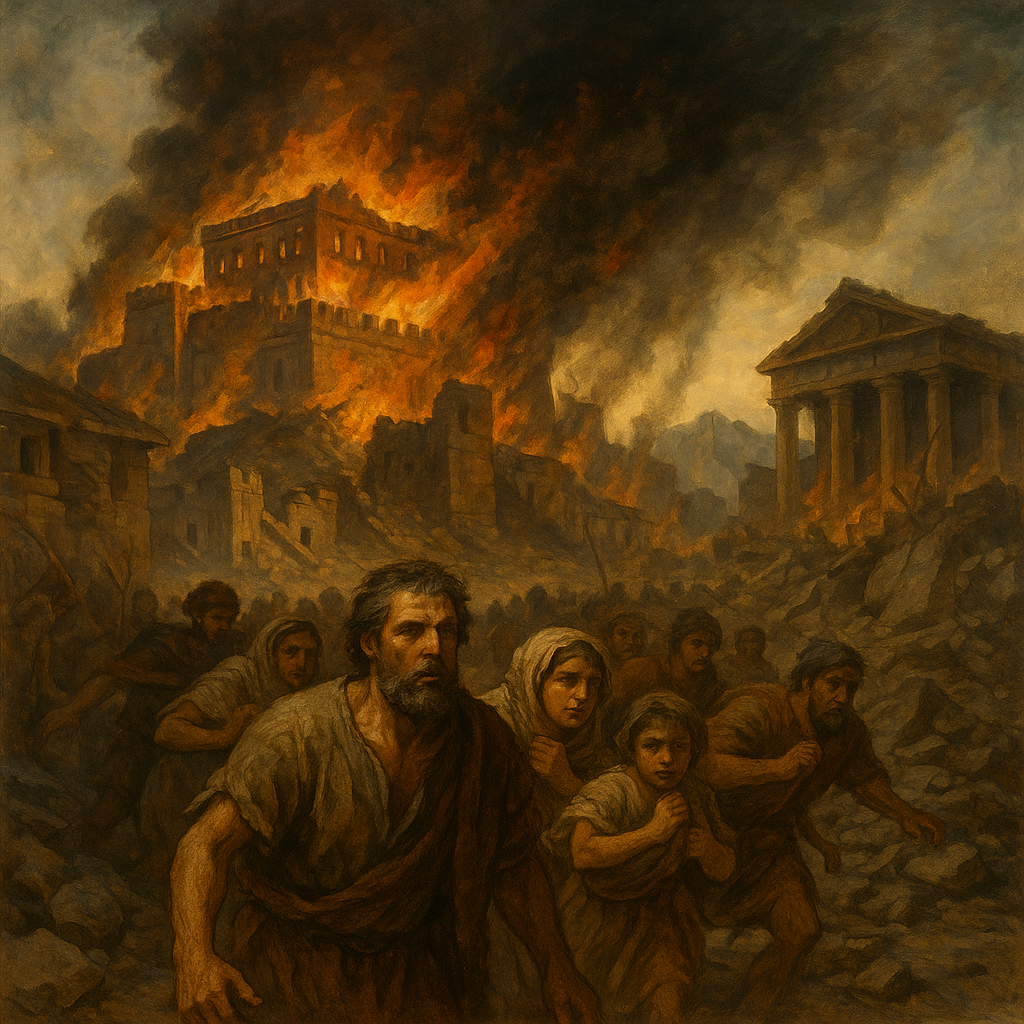
Around 1200 BCE, the world’s first great networked civilization collapsed almost simultaneously. The Mycenaeans in Greece, the Hittites in Anatolia, the Canaanite city-states, even mighty Egypt — all fell into turmoil within a few decades. Palaces burned. Trade routes vanished. Writing systems disappeared. Populations scattered.
For centuries, archaeologists have called it the Bronze Age Collapse — a phrase that sounds like a mystery, but increasingly looks like a pattern. A pattern of interconnected systems pushed beyond their capacity to adapt.
And if that sounds familiar in 2025, it’s because it should.
🌍 The First Globalized World
The Late Bronze Age was not primitive. It was, in many ways, the first experiment in globalization. Across the eastern Mediterranean stretched a web of powerful kingdoms — Egypt, the Hittite Empire, Mycenaean Greece, Ugarit, and others — bound together by trade, diplomacy, and data (in the form of cuneiform tablets).
Copper from Cyprus met tin from Afghanistan to make bronze. Grain from Egypt fed cities in the Levant. Texts in Akkadian — the lingua franca of the age — moved between royal courts as today’s emails move between ministries.
It was a complex, optimized system. Every palace depended on the next. And like our own global network, it worked brilliantly — until it didn’t.
⚔️ The Great Unraveling
Around 1200 BCE, things started to go wrong. Climate records show a series of prolonged droughts and crop failures. Famine spread. People moved in search of food and stability. Trade routes became dangerous. The Sea Peoples, waves of displaced groups, attacked coastal cities.
At the same time, internal tensions grew. The great palaces, bloated with bureaucracy, couldn’t adapt fast enough.
When Ugarit — a vibrant port in modern Syria — sent desperate letters to its allies, the pleas arrived too late.
The city was burned and never rebuilt.
In less than a century, an entire network of civilizations collapsed. Not with one single catastrophe, but with a thousand interlocking failures. Economists today would call it a systems collapse.
🧩 The Modern Mirror
Fast forward three thousand years. We don’t smelt copper in Cyprus anymore, but our dependencies look eerily similar.
Let’s unpack the parallels.
1. Global Interdependence → Systemic Fragility
Then, the Bronze Age economy was built on specialization: each region produced a piece of the puzzle.
When trade faltered, everyone suffered. Now, global supply chains function the same way. A semiconductor factory in Taiwan, a cargo ship in the Red Sea, or a pipeline in Ukraine — one disruption, and the whole network trembles. Efficiency gives us power, but reduces our margin for error. The ancient world learned that lesson the hard way. We may be next.
2. Climate Change and Resource Scarcity
Inscriptions from the era speak of famine so severe that “people ate their own children.” Behind those words lie years of drought, failed harvests, and social unrest. Our climate models tell a similar story — one just beginning to unfold. From wildfires to floods, we see how environmental stress can destabilize regions, spark migration, and strain institutions. The parallel is chilling: both then and now, climate doesn’t destroy civilizations directly — it exposes their weaknesses.
4. Technological Disruption and Economic Shifts
Iron replaced bronze not because it was better — at first, it wasn’t — but because it was cheaper and more accessible. This democratization of technology upended the old elite order built around bronze trade monopolies. Old systems couldn’t pivot.
Sound familiar? Automation, AI, renewable energy — all are reshaping economies faster than institutions can adapt. Like the Hittite palaces, some of our modern structures risk becoming too rigid to survive transformation.
5. Institutional Overcomplexity and Loss of Trust
When famine hit and trade failed, the bureaucratic palaces of Mycenae and Hattusa couldn’t deliver relief. They taxed more, produced less, and lost legitimacy. Eventually, people walked away — literally. Villages replaced cities.
We see modern versions of this in political polarization, disinformation, and the erosion of public trust. Our governments, corporations, and even media systems have grown intricate — but not necessarily adaptive. Complexity without flexibility is fragility wearing armor.
6. Information Collapse
After the Bronze Age Collapse, writing itself disappeared from much of the Aegean world for centuries. It wasn’t just administration that failed — it was collective memory. The ability to transmit knowledge, coordinate, and preserve history vanished.
Today, we risk a different kind of information collapse — not through silence, but through noise. Misinformation, algorithmic bubbles, and AI-generated confusion erode our shared understanding of truth. It’s possible to drown in data and still know nothing.
🧠 Lessons in Systems Thinking
The Bronze Age Collapse wasn’t about heroes or villains. It was about systemic fragility in a world optimized for stability — until instability arrived. If we analyze it like data engineers, we might see:
Single points of failure (tin trade → bronze shortage).
Overfitted systems (palatial economies unable to generalize to crisis).
Cascading failures (loss of one node toppling others).
It’s the same logic that governs cloud outages, supply chain meltdowns, or social network implosions. Ancient history, read through a systems lens, becomes an early dataset in civilizational resilience analytics.
⚖️ Resilience Over Efficiency
Every civilization faces the same equation: Efficiency vs. resilience. The Late Bronze Age chose efficiency — and lost everything.
Resilience means redundancy, adaptability, and local autonomy. It’s not glamorous, but it’s what survives collapse. Iron Age societies that followed — Phoenicians, Israelites, early Greeks — thrived not because they were richer, but because they were simpler and more flexible.
In our age of AI-driven logistics and data-optimized everything, this lesson is vital. We can’t eliminate complexity, but we can design for graceful degradation — systems that fail slowly, not suddenly.
🏛️ Civilization as a Data System
Imagine a civilization as a data pipeline: Resources in, transformations in the middle, culture and stability out. If one stage corrupts — a broken link, a missing input, a wrong schema — the whole system outputs noise.
That’s what happened in 1200 BCE.
And it’s what could happen to us — whether the input is truth, trust, or energy. Civilizations collapse when their feedback loops fail faster than they can be corrected.
🔮 Three Thousand Years Later
The Bronze Age didn’t end because people forgot how to make bronze. It ended because the world it depended on stopped working.
Our challenge today isn’t ignorance — it’s inertia. We can see the patterns, model the data, even predict the collapse curves.
What’s missing is the will to act before the system crosses a tipping point.
So perhaps the real question is not whether we’ll collapse, but how we’ll rebuild —
and whether the next age will learn from the last one.
🪶 Epilogue
If our networks fell silent tomorrow — if the cloud dimmed, the cables broke, and the data vanished — what would remain resilient? The algorithms? The servers? Or the people who still know how to grow food, make fire, and tell stories?
That’s the timeless lesson from 1200 BCE: Technology fades. Systems fail. But meaning — if we preserve it — endures.